
What Are GROW Games? The Eyezmaze Series Explained
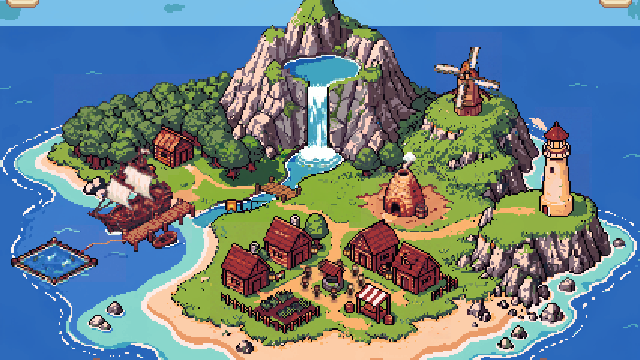
A GROW game gives you a handful of items and one decision to make about each: when to use it. You do not aim, you do not race a timer, and you cannot lose by being slow. You pick an order, press play on the world, and watch what your order turned into. That is the whole genre, and it has kept people busy for over twenty years.
Who made them
The series comes from On Nakayama, a Japanese independent developer who published his games at eyezmaze.com. The first one, confusingly titled GROW ver.3, went up in February 2002. Nakayama made them alone, in Flash, with a soft hand-drawn look that almost nobody has managed to copy convincingly.
The naming has always been a joke at the player's expense. GROW ver.3 came first. GROW ver.2 arrived in June 2006, and GROW ver.1 in December 2006, four years after the "third" one.
How a GROW game actually works
Every GROW game runs the same loop:
- You are shown a world and a small panel of items.
- You pick one item. It appears in the world at its lowest level.
- Everything already in the world tries to advance one level.
- Repeat until the panel is empty, then watch the ending you earned.
The trick is in step 3. Each item only levels up when the things it depends on are far enough along, so an item placed early gets many chances to grow, and an item placed last gets exactly one. Your order is really a budget: you are deciding who gets time and who does not.
Get it right and every piece reaches its top form and the world becomes something absurd and wonderful. Get it wrong and you get a stunted, half-built version of the same world, which is somehow more memorable than the win.
The main series
Twelve main titles, plus a side line of smaller ones:
| Title | Released |
|---|---|
| GROW ver.3 | February 2002 |
| GROW RPG | July 2005 |
| GROW Cube | September 2005 |
| GROW ver.2 | June 2006 |
| GROW ver.1 | December 2006 |
| GROW Island | September 2007 |
| GROW Tower | January 2009 |
| GROW Valley | August 2010 |
| GROW Cannon | January 2011 |
| GROW Maze | March 2013 |
| GROW Clay | February 2014 |
| GROW Park | July 2015 |
The MiniGROW line ran alongside it: GROW ORNAMENT in December 2005, the GROW Nano games from 2006 to 2011, then GROW Cinderella in October 2016, GROW Comeback in June 2018 and GROW Thanks in November 2018.
Where to start
GROW Cube is the one people mean when they say they played a GROW game. It is the cleanest expression of the idea: ten items, a floating cube, and an ending that is worth the failures. GROW Island and GROW Valley are the friendlier ones if Cube frustrates you.
What happened after Flash
These were Flash games, and Flash reached end of life at the end of 2020. Nakayama ported much of the catalogue to HTML5 before that happened, so the games did not vanish with the plugin, and GROW Cube also reached Android and iOS in late 2014. The Flash versions shut down along with Flash itself.
New releases stopped after 2018. That is a large part of why people still search for games like these: the originals are finite, and there were never very many of them.
Why the idea survived
Order puzzles are cheap to explain and expensive to solve. There is no tutorial to write, no controls to learn, and no reflexes involved, so anyone can start. But eight items already means 40,320 possible orders, and the solution space is not something you can feel your way through by instinct.
They also fail in an entertaining way. Most puzzle games punish a wrong move with a buzzer. A GROW game shows you exactly what your bad idea did to the world, in animation, and lets you sit with it. Failure is content.
The genre's real invention is that losing is worth watching.
Try one right now Island Evolution is an original order puzzle in the same spirit: 8 items, 40,320 orders, 3 of them perfect. Free, no download.
▶ Play freeSources
- GROW (series) on Wikipedia, for titles and release dates.
- eyezmaze.com, On Nakayama's own site.